Where Did All the Breweries Go? Is There a Craft Beer Crisis?
Table of Contents
- The Rapid Decline: Understanding Recent Brewery Closures
- Craft Brewery Closures: What Happened in North Georgia
- Challenges for Small Breweries in Today’s Market
- Market Saturation and the Rationalization Period
- Craft Spirits vs Beer: A Survival Strategy
- Why Supporting Local Breweries Matters Now
- Conclusion
Last Updated: August 13, 2026
The Rapid Decline: Understanding Recent Brewery Closures
Over the past two years, the craft brewing landscape has shifted dramatically. Taprooms that once felt permanent fixtures in their communities have shuttered their doors. Breweries that launched with bold ambitions and packed opening nights have quietly ceased operations. The question echoing through conversations at remaining bars isn’t just “where did all the breweries go?”, it’s why so many couldn’t survive.
The craft beer industry experienced explosive growth for nearly two decades. What started as a countercultural movement became a mainstream phenomenon. But growth that steep inevitably invites correction. The market saturation that defines today’s craft beer space wasn’t created overnight. It built gradually as founders saw opportunity, invested capital, and opened taprooms in markets that couldn’t support them all. Now that reality is settling in.
From the beginning, NoFo has been about creating a welcoming “third place” where people can gather, celebrate, share stories, and build meaningful connections within their community. This philosophy has guided the company since opening in Cumming, GA in 2019, and it’s precisely why understanding and navigating the broader industry crisis matters. The breweries that survive aren’t just the ones with the best beer, they’re the ones that recognized community connection as their actual product.
Craft Brewery Closures: What Happened in Georgia
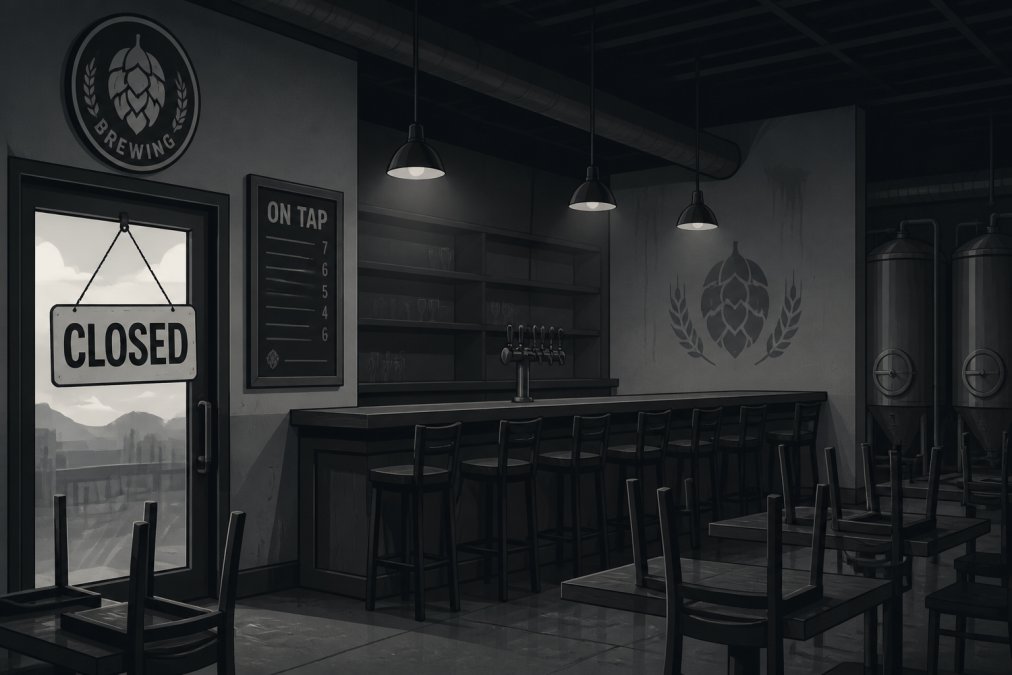
Georgia has been hit particularly hard by recent brewery closures. The region saw explosive growth in craft brewing operations through the early 2020s, with new taprooms opening regularly across Forsyth and Hall Counties … and in Metro Atlanta as well. That growth created a false sense of stability. It didn’t. Several established Georgia-based breweries have closed their doors in the past 24 months. These weren’t fly-by-night startups. Many had loyal customer bases, hosted community events, and seemed embedded in local identity. Yet even that wasn’t enough. Below is a list of the last three fiscal years’ closures around the state of Georgia.
2023
- Second Self Beer Company — Atlanta
- Burnt Hickory Brewery — Kennesaw
- Anderby Brewing — Atlanta
- Candler Rail Brewery — Atlanta
- Biggerstaff Brewing — Old Fourth Ward, Atlanta
2024
- Dry County Brewery — Kennesaw
- Steady Hand Beer Co. — West Midtown, Atlanta
- Elsewhere Brewing — Grant Park & West Midtown, Atlanta
- Eventide Brewing — Grant Park, Atlanta
- Kettlerock Brewing — Peachtree Corners
- Iron Hill Brewery — Buckhead, Atlanta
- Torched Hop Brewing — Midtown, Atlanta
- Best End Brewing — West End, Atlanta
- Moon River Brewing — Savannah
- Liquid Nation Brewing (LNB) — Gainesville
2025
- High Card and Blue Tarp — Tucker
- Red Hare Brewing — Marietta
- Monkey Wrench — Atlanta
- Jekyll Brewing — Alpharetta, Woodstock, Gainesville (plus Jacksonville Beach, FL)
Markets are Oversaturated
The closure pattern reveals something important about brewery economics in a saturated market. A successful taproom requires consistent foot traffic, strong wholesale distribution channels, operational efficiency, and the ability to weather economic pressure. When multiple pressures hit simultaneously, which is exactly what happened starting in 2024, even established operations can’t absorb the shock. For many of these breweries, when consumer spending tightened in 2024 and 2025, the math stopped working.
What made these closures particularly significant is that they weren’t isolated failures. They reflected systemic stress across the entire regional industry. The rationalization period that industry analysts predicted has arrived. Markets that became oversaturated with craft beer options are now consolidating. Weaker operators are exiting. Stronger ones are adapting or, in the case of NoFo, actively acquiring assets from competitors and expanding their footprint. From the beginning, NoFo has been about creating a welcoming “third place” where people can gather, celebrate, share stories, and build meaningful connections within their community. This philosophy enabled the company to weather the downturn and acquire Tantrum’s Cleveland, GA location in June 2023, transforming a taproom into an opportunity for operational consolidation and community continuity.
The regional pattern also reflects a broader truth: breweries that relied primarily on beer sales and novelty-driven taproom traffic struggled more than those offering diversified beverage portfolios. Operations that had invested in spirits production, food partnerships, or event programming showed greater resilience. This distinction became increasingly clear as 2024 progressed and consumer spending shifted away from discretionary craft beer purchases.
Challenges for Small Breweries in Today’s Market
Small breweries face a fundamentally different operating environment than they did just three years ago. The challenges aren’t theoretical. They’re immediate and compounding. Brewery owners also don’t want to increase prices on their customers, but many are forced to, they don’t have a choice.
Rising Operating Costs and Supply Chain Strain
Brewery operations are capital-intensive by nature. You need fermentation tanks, cooling systems, packaging equipment, and highly trained staff. Those costs have escalated significantly. Labor expenses have risen as the tight employment market persists. Energy costs remain elevated. Ingredient sourcing, while more stable than during the pandemic, still carries uncertainty and premium pricing compared to pre-2020 levels.
Raw materials represent a substantial portion of brewery overhead. Hops, malt, and specialty ingredients don’t have stable pricing. A small brewery ordering in modest volumes has less negotiating power than larger regional or national producers. That cost disadvantage compounds across hundreds of brewing batches annually.
Supply chain disruptions, while less acute than 2021-2022, haven’t fully normalized. Packaging materials, cans, bottles, labels, still face occasional shortages and price volatility. A brewery with limited capital reserves can’t absorb a sudden 15-20% increase in packaging costs. Larger operations can negotiate multi-year contracts or shift production to absorb the impact. Small breweries often can’t.
Then there’s the tariff wildcard. Section 232 tariffs pushed steel and aluminum duties to 50% by June 2025, and since aluminum cans account for roughly 75% of packaged craft beer volume, the cost of a single can has climbed sharply — one brewery reported their per-can cost jumping from about 15 cents to 35 cents. It’s not just cans, either: kegs, brewhouse equipment, and tanks all lean on imported steel and aluminum, and even replacement parts for canning lines have doubled in price for some brewers, leaving small operators with none of the volume leverage that lets larger players absorb the hit.
The squeeze is real. Operating margins that were acceptable at 30% profitability become untenable at 15%. When you’re running on thin margins and facing simultaneous pressure on multiple cost centers, the math stops working.
Changing Consumer Drinking Habits
Consumer preferences have shifted in ways that directly threaten traditional craft beer positioning. The craft beer drinker of 2019 was often a specific demographic: primarily male, 25-45, willing to pay premium prices for novelty and perceived quality. That consumer still exists, but the market has fragmented.
Hard seltzers captured significant market share from beer. Spirits, particularly agave-based spirits and craft cocktails, have become increasingly popular. Wine consumption remains mostly steady. Most significantly, younger drinkers (21-30) are drinking less alcohol overall compared to previous generations, and when they do drink, they’re more likely to choose spirits or ready-to-drink cocktails than beer in an on-premise setting.
This represents a fundamental demand shift. A brewery that built its business model on consistent beer consumption growth is now competing in a fast-shrinking category. That’s not a temporary trend. Demographic and cultural patterns don’t reverse quickly.
NoFo recognized this reality and adapted strategically. The company operates as both a craft brewery and a craft distillery, producing bourbon, agave spirit, vodka, gin, and specialty spirits in-house. This diversification isn’t just about revenue streams, it’s about meeting consumer demand where it actually exists rather than where nostalgia suggests it should be.
Market Saturation and the Rationalization Period
The craft beer industry entered what industry observers call a “rationalization period.” This is a polite term for what amounts to market correction through closures and consolidation. But understanding why some regions are consolidating faster than others, and which markets still have room for growth, reveals the real story behind brewery closures.
During the expansion phase (roughly 2010-2022), opening a craft brewery felt like a viable business plan. Consumers were eager for local options. Distribution channels were opening up. The barrier to entry, while substantial, seemed surmountable for passionate entrepreneurs with capital. The Brewers Association reported that the number of operating breweries in the United States grew from approximately 1,700 in 2010 to over 9,000 by 2022. That explosive growth masked a critical problem: market capacity.
A city of 100,000 residents can support a finite number of breweries. Industry benchmarks suggest one brewery per 10,000-15,000 residents is sustainable; beyond that, you enter over-saturation. Many metropolitan areas in the Southeast, including parts of Georgia, exceeded this threshold by 2022. When you exceed it, you create a situation where every brewery is competing for the same customer base with similar products. Price pressure increases. Volume requirements increase. Profitability decreases. Big players ride out the storm, while the small ones fold and go out of business.
But the rationalization isn’t uniform across the country. States like Colorado and Oregon, which experienced earlier saturation, have already consolidated to more sustainable brewery-per-capita ratios. Their remaining operators have adapted, diversified, and stabilized. Regions that expanded later, including much of the Southeast, are experiencing the correction now, which is why 2024 and 2025 saw elevated closure rates in states like Georgia, North Carolina, and South Carolina.
This geographic disparity matters because it reveals which breweries are most vulnerable. Operations in markets that haven’t yet reached saturation equilibrium face ongoing pressure. Those in markets that have already consolidated and stabilized face less competition for remaining consumer dollars. Georgia’s position in this cycle, mid-consolidation, explains why established breweries faced pressure despite years of operation and community presence.
The rationalization that’s happening now is the inevitable result of oversupply meeting shifting consumer demand. Weaker operators exit. Market share consolidates among stronger competitors. Remaining breweries become more efficient, more strategic, and more focused on differentiation. Operators that diversified into spirits, like NoFo, gained a competitive advantage because they could capture consumer spending that was shifting away from beer into higher-margin categories.
This isn’t unique to beer. It’s a standard industry lifecycle. Retail, restaurants, fitness studios, any sector with low barriers to entry experiences this pattern. The craft beer industry is simply experiencing it now, several years later than some observers predicted. What distinguishes survivors from closures in this phase is not just product quality but operational flexibility, capital reserves, and the willingness to evolve the business model beyond the original product category.
Craft Spirits vs Beer: A Survival Strategy
The most successful craft beverage producers in 2026 are the ones who recognized that beer alone isn’t a sustainable business model. Diversification into spirits (and other products) represents both a defensive move and an opportunity.
Craft spirits production requires different infrastructure, different expertise, and different regulatory compliance than brewing. It’s not simple. But the market dynamics are more favorable. Spirits consumption has grown while beer consumption has plateaued. Profit margins on spirits typically exceed those on beer. Consumer perception of craft spirits remains elevated, the category hasn’t experienced the same saturation as craft beer.
For NoFo, the integration of craft spirits production alongside brewing created operational advantages. It allows the company to serve customers with different preferences. It creates multiple revenue streams from the same taproom footprint. It positions the brand as a beverage company rather than just a brewery.
This diversification strategy mirrors what successful regional beverage companies have done across the country. The operators that survived the rationalization period weren’t necessarily the ones making the best beer. They were the ones who understood that consumer preferences had shifted and adapted their product portfolio accordingly.
Why Supporting Local Breweries Matters Now
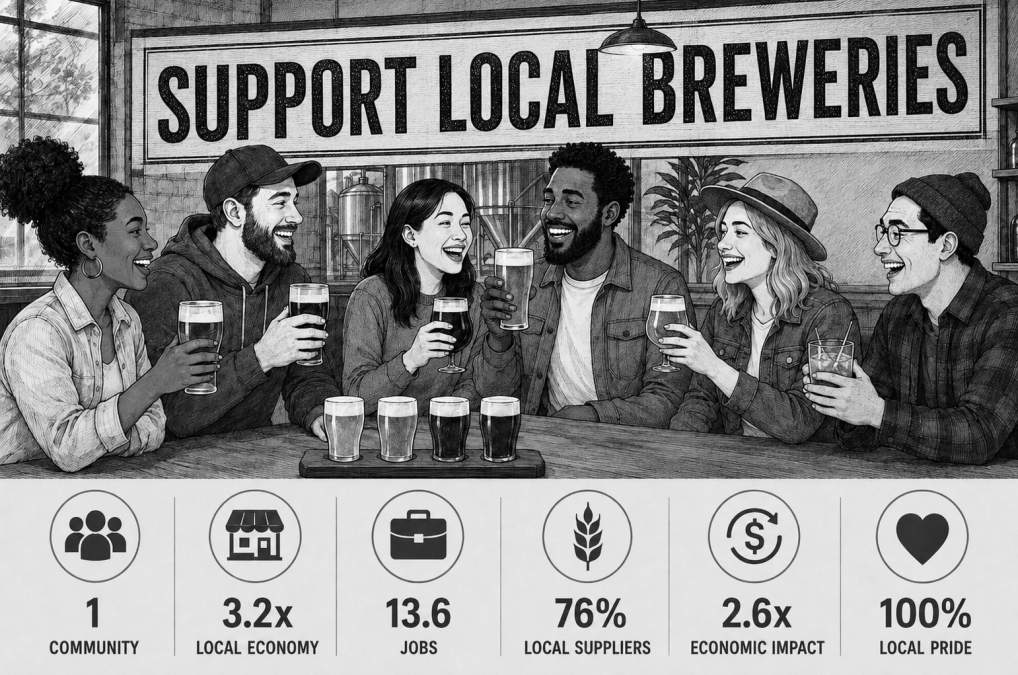
The closure of local breweries represents more than just lost businesses. It represents the loss of community gathering spaces and the local employment they provided.
A functioning taproom is a “third place“, neither home nor work, but a space where community members gather, build relationships, and create shared experiences. When these spaces close, the community loses something tangible. The economic multiplier effect disappears. The local employment vanishes. The sense of place diminishes.
Supporting local breweries and craft beverage producers that have survived the rationalization period is an investment in community stability. It’s a choice to sustain the spaces and businesses that define local character. It’s recognition that some things matter beyond pure market efficiency.
When you choose to spend your evening at a local taproom rather than a chain establishment, you’re making a choice about what kind of community you want to live in. You’re supporting local employment. You’re sustaining a gathering space. You’re voting with your dollars for the continuation of local character and community connection.
The craft breweries and beverage producers that remain standing have earned that support. They’ve navigated an extraordinarily challenging operating environment. They’ve adapted to changing consumer preferences. They’ve invested in their communities through good times and difficult ones. That resilience deserves recognition and your dollars.
The rationalization of the craft beer industry isn’t a crisis, it’s a correction. Markets evolve. Consumer preferences shift. Unsustainable business models fail. What emerges from this period are operators who understood that survival requires adaptation, diversification, and genuine community commitment. NoFo Brew Co represents exactly that kind of operator: a company that produces exceptional craft beer and craft spirits while maintaining three thriving taprooms that genuinely function as community gathering spaces. If you’re looking for where the breweries went, look for the ones still standing. They’re the ones worth supporting.
Frequently Asked Questions
Why are so many craft breweries closing recently?
Craft brewery closures stem from multiple pressures: rising costs for raw materials and labor, market saturation that eroded profit margins, and shifting consumer demand toward spirits and hard seltzers. Economic inflation increased overhead expenses while competition from larger regional breweries made it harder for smaller operations to maintain market share. Many breweries that opened during the craft beer boom of the 2010s now face a rationalization period where only the most adaptable survive.
What are the primary economic challenges facing small breweries today?
Small breweries struggle with capital expenditure requirements, supply chain disruptions affecting ingredient availability, and labor shortages that drive up production costs. Distribution remains expensive and competitive, especially for breweries trying to expand beyond their local wholesale and retail networks. Without the economies of scale that larger producers enjoy, independent breweries absorb higher per-unit costs, squeezing already thin profit margins in an oversaturated market.
How does the closure of local breweries impact community culture?
Brewery closures eliminate gathering spaces where people connect and build relationships. Taprooms serve as third places where communities celebrate, share stories, and create meaningful connections. When these venues disappear, neighborhoods lose not just a business but a social anchor. Supporting the breweries that remain—especially those offering diverse products like craft spirits alongside beer—helps preserve these vital community hubs.
Are craft spirits helping breweries stay in business?
Yes. Breweries that diversified into craft spirits production have better survival odds because spirits command higher profit margins than beer and appeal to broader consumer preferences. By offering both craft beer and craft spirits, producers can capture revenue from customers seeking different experiences and drinking occasions. This diversification strategy has become essential for independent breweries navigating the current market correction.