
NoFo’s Core Convictions: WHY They Matter
Table of Contents
- Core Convictions vs. Company Values: The Critical Difference
- The Story Behind NoFo’s Core Convictions
- Examples of Failed Corporate Values in Industry Giants
- How Core Convictions Shape Organizational Culture
- How to Build a Strong Company Culture Around Convictions
- Employee Accountability and Core Values in Action
- Why Team Members Memorize and Live NoFo’s Convictions
- The Impact of Core Convictions on Customer Experience
- Conclusion
Last Updated: August 11, 2026
Core Convictions vs. Company Values: The Critical Difference
Most organizations frame their principles as company values and call it done. They get printed on a poster, framed on a wall, maybe mentioned during onboarding. Then they collect dust.
Core convictions are different. They’re not aspirational statements hanging in a break room. Core convictions are lived, breathed, and embedded into how decisions get made every single day. The distinction matters because values without conviction become meaningless, they’re just words. At NoFo Brew Co, core convictions function as the operational backbone of organizational culture, not decorative statements.
Core convictions are what you are convicted by.
The difference comes down to conviction. Company values describe what an organization says it stands for. Core convictions describe what an organization is actually willing to fight for. When a team member at NoFo faces a decision, whether it’s how to treat a customer, how to handle a conflict with a peer, or how to allocate resources, the core convictions provide the framework. They’re not suggestions. They’re the foundation that guides behavior when it matters most.
From the beginning, NoFo has been about creating a welcoming “third place” where people can gather, celebrate, share stories, and build meaningful connections within their community. That mission isn’t just marketing language. It’s embedded in every decision the company makes, from how staff interact with guests to how the organization approaches community engagement. Core convictions make that possible.
The Story Behind NoFo’s Core Convictions
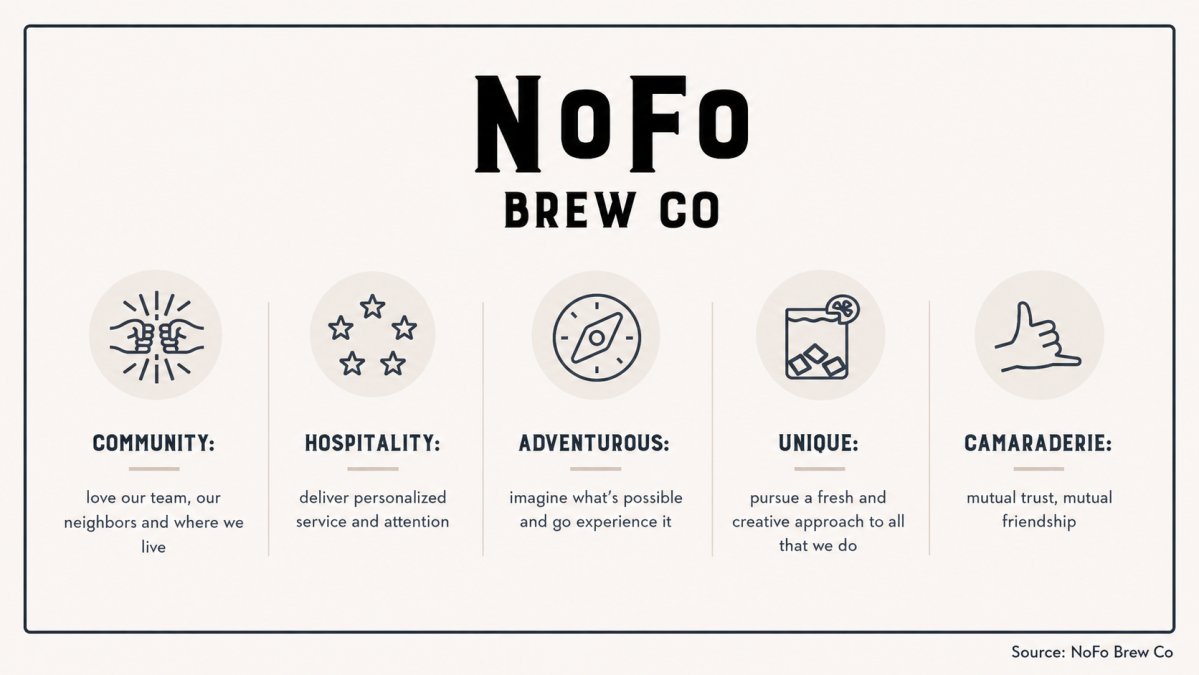
NoFo didn’t start with a consultant’s framework or a corporate retreat brainstorming session. The core convictions emerged from the founding vision and the lived experience of building something from scratch. they emerged from a meeting where the senior leaders of the business got together and talked about the attributes they actually saw over the first 18 months of NoFo’s existence. Many words were suggested, but five bubbled to the top.
1) Unique, 2) Community, 3) Adventurous, 4) Camaraderie, & 5) Hospitality
When Bryan & Shannon Miles and Joe Garcia co-founded NoFo Brew Co in 2018, they weren’t just starting another craft brewery. They were building a gathering space with a specific purpose: to create community. That purpose became the seed from which core convictions grew. Every decision, from the physical design of the taprooms to the hiring process to how staff engage with guests, flowed from that central conviction about what NoFo exists to do.
The convictions remained as the company scaled from one location in Cumming to three taprooms across North Georgia. Each location brought new challenges: How do you maintain culture when you’re no longer in one room together? How do you hire people who understand what you’re trying to build? How do you make decisions that honor your founding vision while adapting to new markets?
What makes NoFo’s approach different is that the convictions aren’t theoretical. They’re tested constantly. When the company acquired Tantrum Brewing’s assets in Cleveland in 2023, the first instance of one independent Georgia craft brewery acquiring another, the core convictions provided the framework for integrating a new team and location. The question wasn’t “What’s the most efficient way to do this?” It was “How do we do this in a way that honors our core convictions?”
That integration process revealed something critical: core convictions only work if every team member understands them deeply enough to make decisions aligned with them. That’s why each team member at NoFo is expected to memorize the core convictions and state them out loud to their leaders and peers. It’s not about compliance. It’s about internalization.
Examples of Failed Corporate Values in Industry Giants
History provides clear examples of what happens when organizations treat values as decorative rather than operational. These cases illustrate why core convictions matter and what happens when they erode.
Enron’s stated values included integrity and communication. The company’s leadership printed these values on wallet cards. Employees carried them. The company talked about them in presentations. Yet the entire organization collapsed under the weight of systematic fraud, deception, and a culture that rewarded dishonesty at every level. The values weren’t convictions, they were cover. When it mattered, the organization chose profit over principle. The gap between stated values and lived behavior became so wide that it destroyed the company.
Wells Fargo built its reputation on trust and customer focus. The bank’s values emphasized doing right by customers. Then the organization created incentive structures that directly contradicted those values, leading to the creation of millions of fraudulent accounts. Employees opened accounts customers didn’t authorize because the system rewarded volume over integrity. The values were real in the mission statement. The convictions weren’t there to back them up. When the incentive system conflicted with stated values, the convictions lost every time.
Boeing built its reputation on engineering excellence and safety as a non-negotiable. “Safety, Quality, Integrity” sat at the top of the company’s values statement. Then leadership rushed the 737 MAX to market to compete with Airbus, pressuring engineers to certify a new flight-control system under an existing pilot-training umbrella to save time and money. Internal messages later revealed employees mocking the very jet they were certifying as safe. Two crashes and 346 deaths later, the values were still on the website. The conviction to slow down and do it right, even when it cost market share, wasn’t there.
These examples share a pattern: organizations state values, but when those values conflict with profit, growth, or convenience, the organization chooses the latter. That’s because values without conviction are just words. Core convictions, by contrast, are principles that an organization is willing to sacrifice for. They’re tested under pressure, and they either hold or they don’t.
The reason these examples matter is that they show what organizational culture actually looks like when core convictions are absent. It’s not that the companies didn’t have values. It’s that the values weren’t convictions, they weren’t deeply held principles that guided decision-making when it was hard.
How Core Convictions Shape Organizational Culture
Organizational culture isn’t created by mission statements, values posters, or silly awards. It’s created by the consistent, visible choices leaders and team members make when nobody’s watching.
Core convictions shape culture by providing a decision-making framework that extends beyond what any policy manual could cover. When a team member encounters a situation that isn’t explicitly addressed in company policy, they can refer back to the core convictions. What would honoring this conviction look like in this specific moment? That framework creates consistency in how people behave, even when circumstances change.
Consider the difference in how two organizations might handle a customer complaint. Organization A has a customer service policy. Organization B has a core conviction about treating customers with respect and transparency. When a customer has an unusual problem that doesn’t fit neatly into the policy, Organization A’s employee is stuck. Organization B’s employee can refer to the conviction and make a decision aligned with it.
That distinction scales. When an organization has hundreds or thousands of employees, you can’t write a policy for every situation. You need a shared framework, a set of core convictions that guides behavior consistently. NoFo operates three separate locations with different teams. The core convictions create alignment across those locations without requiring centralized control of every decision.
Core convictions also shape culture by signaling what the organization actually values. If leaders talk about community but make decisions that prioritize profit, the team learns that community is just marketing language. If leaders talk about transparency but hide information, the team learns not to trust transparency. The inverse is also true: when leaders consistently make decisions that honor stated convictions, even when those decisions are costly, the team learns that the convictions are real.
This is why memorizing and reciting core convictions matters at NoFo. It’s not about rote memorization. It’s about making sure every team member can articulate the framework that guides their work. When you can state your convictions out loud, you’re more likely to make decisions aligned with them.
Culture is Shared Vision: How to Build a Strong Company Culture Around Convictions
Building a culture around core convictions requires intentional design at every stage: hiring, onboarding, decision-making, and feedback.
Start with clarity. The convictions need to be specific enough to guide behavior. “We value integrity” is too vague. “We tell customers the truth about what we can and can’t do, even when honesty costs us business” is a conviction that guides behavior. The more specific the conviction, the more useful it is as a decision-making framework.
Embed convictions into hiring. The most effective way to build culture is to hire people who are already aligned with your convictions. This means asking interview questions that surface whether a candidate actually holds the convictions you’re looking for, not just whether they understand them intellectually. A question like “Tell me about a time you chose the harder right over the easier wrong” reveals whether someone has a track record of acting on conviction.
Make convictions visible in onboarding. New team members should encounter the convictions on day one, not as a document to read but as a framework they’ll use to make decisions. Walk them through examples: “Here’s a situation that came up. Here’s how we approached it through the lens of our core convictions. Here’s what that decision cost us and why we made it anyway.”
Test convictions under pressure. The real test of whether a conviction is operational comes when honoring it is costly. If your conviction is “we prioritize customer experience over short-term revenue,” what happens when honoring that conviction means losing a big sale? Do you actually do it? Do leaders visibly support the decision? The team is watching. They’ll calibrate their own behavior based on what they see.
Create feedback loops. Team members need to know whether their decisions are aligned with core convictions. This means regular, honest feedback about how their choices reflect (or don’t reflect) the stated convictions. It also means leaders need to be open to feedback about whether their own decisions are aligned.
The most common mistake organizations make is treating convictions as a one-time communication. You announce the values, maybe do a workshop, and then move on. Real cultural change requires consistent reinforcement, visible modeling from leaders, and integration into every system: hiring, evaluation, promotion, resource allocation.
Employee Accountability and Core Convictions in Action
Accountability is where core convictions become real or reveal themselves as empty.
When team members are expected to memorize and recite core convictions, as they are at NoFo, that expectation creates accountability. You’re not just supposed to understand the convictions. You’re supposed to be able to articulate them. That’s a higher bar than passively reading them in an employee handbook.
Accountability means consequences. If a team member makes a decision that violates a core conviction, there need to be real consequences. Not necessarily termination, but real feedback and correction. Conversely, when a team member makes a decision that honors a conviction, especially when that decision was hard or costly, that needs to be recognized and celebrated.
The challenge with accountability is that it requires leaders to be consistent. If leadership enforces convictions selectively (holding junior staff accountable but giving senior leaders a pass), the culture erodes. If convictions are enforced only when it’s convenient, team members learn that they’re not actually convictions. They’re just suggestions.
Professional integrity is at stake. When a team member commits to living according to core convictions, they’re saying something about who they are. That commitment only means something if the organization actually holds people accountable to it. Otherwise, it’s just performance, saying the right things without meaning them.
The other side of accountability is support. If you’re holding people accountable to core convictions, you need to give them the tools, training, and support to actually live by them. That might mean providing conflict resolution training if one conviction is about honest communication. It might mean backing up a team member who made a decision aligned with convictions even though the decision was unpopular.
Why Team Members Memorize and Live NoFo’s Convictions
The practice of memorizing and reciting core convictions might seem unusual. In most organizations, values are something you read about, not something you memorize. At NoFo, it’s different.
Memorization creates internalization. When you commit something to memory and state it out loud, you’re engaging different parts of your brain than when you simply read it. You’re making it part of your internal framework. Research on memory and behavior change shows that active retrieval, pulling information from memory rather than passively reading it, creates stronger neural pathways and stronger behavioral alignment.
Stating convictions out loud to peers and leaders creates social accountability. It’s one thing to silently agree with a conviction. It’s another to say it out loud in front of people you work with. That public commitment creates a psychological stake in actually living by it.
The practice also creates clarity. When you try to recite something from memory, you quickly discover what you actually understand versus what you just think you understand. If a team member stumbles over articulating a conviction, that’s useful information. It means they need deeper understanding before they can be expected to make decisions based on it.
This approach reflects a specific philosophy about culture: culture isn’t something that happens to you. It’s something you actively choose to be part of. By requiring team members to memorize and recite convictions, NoFo is saying that cultural alignment is a choice and a commitment, not just a passive acceptance of how things are done.

The Impact of Core Convictions on Customer Experience
Core convictions shape how an organization treats customers, and that shows up immediately in the customer experience.
When an organization has genuine convictions about customer care, that’s visible in every interaction. Employees aren’t following a script because they’re afraid of getting in trouble. They’re making decisions aligned with convictions they actually believe in. That creates a fundamentally different quality of interaction.
At NoFo, the conviction about creating a welcoming community directly shapes the customer experience. The taprooms are explicitly designed to be family-friendly and dog-friendly. That’s not a marketing checkbox, it’s a reflection of a conviction about who belongs in these spaces. When a family walks in with kids, they’re not made to feel like they’re in the wrong place. When someone brings their dog, they’re not treated like a burden. This is what “community” looks like to NoFo.
That conviction also shapes how staff handle conflict or problems. If a customer has a complaint, the staff member isn’t trying to minimize the issue or defend the company. They’re approaching the situation through the lens of “how do we honor our commitment to this person?” That’s a different conversation.
Core convictions create customer loyalty that goes beyond product quality. People stay loyal to organizations that reflect their own values. When an organization’s convictions align with a customer’s values, that customer becomes an advocate. They don’t just buy the product. They tell others about the experience.
The inverse is also true. When customers discover that an organization’s stated values don’t match its actual behavior, they leave, often loudly. That’s what happened with the organizations that had value statements but no convictions. Customers felt the gap between what was promised and what was delivered.
Core convictions separate organizations that have a real culture from organizations that have a values statement. They’re what make principles operational instead of decorative. At NoFo, core convictions aren’t something team members read about once during onboarding. They’re something every team member memorizes, recites, and uses to make decisions every single day. That’s the difference between values that inspire and convictions that actually change behavior. Ready to experience a community built on real convictions? Visit one of NoFo’s three taprooms and see how core convictions shape everything from the atmosphere to the way team members engage with guests and everything in between.
Frequently Asked Questions
What's the difference between company values and core convictions?
Company values often sit framed on walls and collect dust. Core convictions are living, breathing beliefs that actively shape decisions and behavior every day. At NoFo, core convictions are so central to the culture that each team member memorizes them and states them aloud to peers and leaders. They're not aspirational—they're operational. They guide conflict resolution, hiring, customer interactions, and strategic alignment.
Why does NoFo require employees to memorize core convictions?
Memorization ensures convictions move from abstract ideals into active practice. When a team member can articulate a conviction out loud, they've internalized it. This creates employee accountability and ensures consistent decision-making across all three taproom locations. It's the difference between knowing what you stand for and actually living it every single day.
How do NoFo's core convictions impact the customer experience?
From the beginning, NoFo has been about creating a welcoming 'third place' where people can gather, celebrate, share stories, and build meaningful connections within their community. This isn't marketing language—it flows directly from core convictions about hospitality, inclusion, and social responsibility. You feel it in the family-friendly atmosphere, the genuine welcome for dog owners, and the way staff engage with every guest.
What happens when a company loses sight of its core values?
History shows the damage. When Wells Fargo abandoned ethical frameworks in pursuit of sales targets, it created a scandal that destroyed trust and required years of recovery. When Uber ignored its own stated values around workplace respect, leadership turnover and cultural dysfunction followed. Companies that drift from convictions experience employee retention problems, stakeholder accountability failures, and damaged reputation. NoFo's commitment to living convictions prevents this erosion.